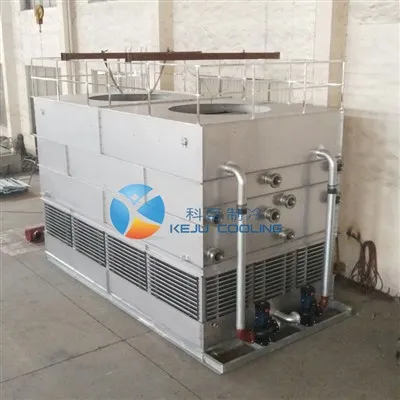
Counter Flow Closed Cooling Tower
Counter flow closed cooling tower(also called evaporative air cooler or closed cooling tower) is the tube heat exchanger is placed in the tower, through the circulation of air, spray water and circulating water heat exchange to ensure the cooling effect.
- Fast Delievery
- Quality Assurance
- 24/7 Customer Service
Product Introduction
Wuxi Keju Machinery Manufacturing Co., Ltd
Wuxi Keju Machinery Manufacturing Co., Ltd. is a high-tech enterprise in Jiangsu Province and is professionally engaged in cooling system development, design, manufacturing, sales, and service. And has 10+ years of experience in the cooling system field. To meet the needs of modern industry development, our closed cooling tower tested in practice has been widely used in automobiles, planes, ships, electric power, chemical industry, food, medical treatment, central air conditioning, forging, casting, heat treatment, experiment platform, and other industries.
Why Choose Us
Years of Experience
Wuxi Keju Machinery Manufacturing Co., Ltd. is a high-tech enterprise in Jiangsu Province and is professionally engaged in cooling system development, design, manufacturing, sales, and service. And has 10+ years of experience in the cooling system field.
Quality System Certification
The company has passed 1OS9001-2008 Quality Management System Certification and worked out Q/320211JDM01-2013 Enterprise Standards. The company was also rated excellent management enterprise of the heat treatment industry in China, third-level enterprise of work safety standardization (machinery) in Wuxi City, cleaner production enterprise in Wuxi City and advanced energy conservation and emission reduction enterprise, and so on.
Professional Technical Team
After more than 10 years of continuous development and growth, the company now has formed a technical personnel team with complete and very high professional level and a production team with strong implementation force.
Excellent Services
The company can complete tasks with high quality and high efficiency, provide users with the best possible services, and also provide on-site training services, enabling operators to master the knowledge and experience necessary for operation, maintenance, and repair.

Cross Flow Closed Circuit Cooling Tower
KEJU cross flow closed circuit cooling tower is suitable for various kinds of cooling systems with high-quality requirements of circulation water, widely used in automobile, plane, ship, electric power, chemical industry, food, medical treatment, central air conditioning, forging, casting, heat treatment, experiment platform, and other industries.

Cross Flow Closed Cooling Tower
KEJU cross flow closed cooling tower is suitable for various kinds of cooling systems with high-quality requirements of circulation water, widely used in automobile, plane, ship, electric power, chemical industry, food, medical treatment, central air conditioning, forging, casting, heat treatment, experiment platform, and other industries.

Cross Flow Closed Type Cooling Tower
This type of closed circuit cooling tower uses a cross-flow design that enables the water to flow in a perpendicular direction to the airflow. This design ensures that the water is evenly distributed across the heat exchange surfaces, leading to efficient cooling performance.

Closed Type Crossflow Cooling Tower
KEJU closed type crossflow cooling tower utilizes the technology of combining coils and PVC fillers for mixed flow secondary heat exchange in the same direction of wind and water, achieving efficient heat exchange.

Cross Flow Closed Loop Cooling Tower
KEJU cross flow closed loop cooling tower is a system used for cooling purposes in various industries and buildings. It is designed to transfer heat from a building or process to the atmosphere, thus maintaining an optimal temperature.

Closed Circuit Cross Flow Cooling Tower
KEJU closed circuit cross flow cooling tower is an advanced cooling system that efficiently removes heat from machinery or other processes in a closed loop system. This type of closed cooling tower is highly efficient and reliable, with a low risk of contamination and minimal water consumption.

Cross Flow Closed Water Cooling Tower
KEJU cross flow closed water cooling tower can work in series as a group for larger capacities. The housing is made of special alloy coated steel or stainless steel, the heat exchange coil is made of stainless steel or copper, and the wet deck filler is made of PVC.

Induced Draft Cross Flow Closed Cooling Tower
In this cooling tower, the warm fluid that needs to be cooled is pumped into the tower and then runs through a heat exchanger where it exchanges heat with the coolant. The heat from the fluid is then transferred to the air through the heat exchanger, and the cooled fluid is then pumped back to the process.

Cross Flow Natural Draft Closed Cooling Tower
KEJU cross flow natural draft closed cooling tower is a modern and advanced technology used in the cooling of industrial equipment and processes. This cooling tower works on the principle of natural draft, which eliminates the need for mechanical fans and reduces operational costs.
What is Counter Flow Closed Cooling Tower
Counter flow closed cooling tower(also called evaporative air cooler or closed cooling tower) is the tube heat exchanger is placed in the tower, through the circulation of air, spray water and circulating water heat exchange to ensure the cooling effect. Because it is a closed cycle, it can ensure that the water quality is not polluted, which protects the efficient operation of the main equipment and improves the service life. When the outside temperature is low, the spray water system can be stopped to save water.
Benefits of Counter Flow Closed Cooling Tower
One of the key benefits of the counter flow closed cooling tower is its high energy efficiency. Unlike traditional cooling towers that use open systems which require a lot of energy to pump water, the counter flow closed cooling tower uses a closed system that recirculates the water. This means that the tower consumes much less energy, making it a highly cost-effective way to cool your industrial facility.
Another great benefits of the counter flow closed cooling tower is its excellent heat exchange performance. These towers use a counter-flow heat exchange process where the cooling water flows opposite to the heated process water. This allows for maximum heat transfer and prevents any contamination of the cooling water, which ensures better cooling efficiency and reduces scaling and corrosion.
Compared with the cross-flow form, the product structure is more compact and has more coil heat dissipation area arrangement, which is more suitable for cooling projects with small temperature difference. because the counter flow closed cooling tower occupies a small ground, plus the circulating water pump, can be made into an all-in-one machine, easy to move.
Counter flow closed cooling tower circulating water is usually soft water closed cycle, effectively prevent the long-term use of the tower or user equipment in the process of scale and damage to the equipment.
Compared with the traditional cooling tower, the counter flow closed cooling tower is more suitable for use in areas with scarce water resources because of the use of a fully closed internal circulation and the use of high-efficiency dehydration devices.

Hot process fluid enters the coil (or tube bundle) from the water intake, and the spray system and fan system are started at the same time. The heat of process fluid undertakes heat transfer via tube walls and is transferred to the spray water running through the outer surface of the tube. The process water becomes cool and then flows out from the water outlet for internal circuit. Driven by the fan, the air outside the unit enters from the air intake, in the opposite direction of water flow, and moves upward through the coil. A small amount of water evaporates and flows through the drift eliminator, collecting the excess moisture into the water tank. Meanwhile, the hot and humid air is dispatched into the atmosphere from the top of the tower. The rest of the water falls into the water tank at the bottom, recycles to the spray system via the water pump, and then returns to the tube bundle.
A significant design difference between a crossflow and counterflow closed cooling tower is the method by which water is distributed over the fill media.
In a crossflow closed cooling tower the process water is pumped to the top of the tower into the hot water distribution basin. The distribution basin is out of the way of the airstream and is gravity fed. The only driving force behind the nozzles is the hydrostatic head of water above the nozzle itself. One advantage of gravity-fed crossflow water distribution is that it can be cleaned while in operation since it is easily accessible from the outside top of the cooling tower.
In a counterflow closed cooling tower, process water is pumped into a sealed header box. The header box then distributes the water into branch arms and nozzles, creating a pressurized water distribution system. Unlike a gravity-fed system, a counterflow tower's water distribution system requires pumps to be shut off to clean the nozzles and the cold water basin. To inspect and clean nozzles, one must enter a crawl space inside the tower.
The exterior casing is often made from galvanized steel or stainless steel, providing corrosion resistance and structural integrity. The heat exchanger coils are usually constructed from premium-grade copper or stainless steel to ensure efficient heat transfer and longevity. The inlet grille is made of corrosion-resistant PVC, and its dual-channel design prevents water splashing and reduces the possibility of algae formation inside the unit. The inlet grille around the sink completely encloses the entire sink and prevents direct sunlight from shining into the unit.
Application of Counter Flow Closed Cooling Tower
Iron and steel metallurgy circulating water cooling cooling, such as blast furnace water-cooled wall circulating water, large motor circulating water, rolling bar internal circulating water.
The oil industry circulating water with counter flow closed cooling tower, to ensure the quality of circulating water, water and energy saving, reduce the pharmaceutical input.
Chemical industry with counter flow closed cooling tower, compared with shell and tube heat exchanger, direct heat dissipation, reduce intermediate links, energy saving and simple.
Refrigeration industry, as the counter flow closed cooling tower, no pollution, no scaling, stable performance, good results.
Testing and commissioning play a crucial role in ensuring the efficiency and effectiveness of a counter flow closed cooling tower. Once the construction of the cooling tower is complete, it is essential to thoroughly test and commission the system before it can be put into operation.
The first step in testing the cooling tower is to conduct a visual inspection. This involves checking for any defects or damages in the structure, such as leaks or cracks. It is important to ensure that the cooling tower is built according to the design specifications and meets all safety standards. Any issues found during the inspection should be addressed and rectified promptly.
Next, the functionality of the cooling tower needs to be tested. This includes checking the performance of the fan, pump, and other essential components. The airflow and water flow rates should be measured and compared to the design specifications to ensure they are within the acceptable range. Any discrepancies should be identified and resolved to ensure optimal performance.
Additionally, the water quality needs to be tested to ensure it meets the required standards. The water used in the cooling tower should be free from impurities and contaminants that can affect its efficiency and lifespan. Testing for parameters such as pH, conductivity, and total dissolved solids is essential to ensure the water is suitable for cooling purposes.
Once the testing phase is complete, the cooling tower can be commissioned. Commissioning involves the final adjustments and fine-tuning of the system to ensure it operates at its full potential. This includes calibrating the controls, setting the operating parameters, and conducting performance tests. The commissioning process also involves verifying the accuracy of the instrumentation and ensuring the safety features are functioning correctly.
Proper testing and commissioning of a counter flow closed cooling tower are essential to ensure its optimal performance and longevity. It helps identify any issues or deficiencies in the system and allows for timely rectification. By following a systematic approach to testing and commissioning, the cooling tower can be successfully put into operation, providing efficient cooling for various industrial processes.

The amount of air flow that is recommended could be too low. The blade level being adjusted could correct the problem.
Your water flow could be over the recommended level. Correct the rate of flow.
If your sprinkler is putting out a poor distribution, the sprinkler output could be impeded. It may require the sprinkler or feed to be replaced.
The water flow was designed to make contact with the files, but this is not happening. Need to check the water supply for leaks, also, check for any issues the sprinkler may be having.
The external air flow going around the tower may be impeded. To find out you need to look for any obstructions of air, and check to see if the exhaust air is being recycled.
The fill is checked or coated. it needs to be cleaned, and might need a replacement.
How to Maintain Counter Flow Closed Cooling Tower
Regarding counter flow closed cooling towers, please keep the surface of the heat dissipation coil clean, ensure the surrounding air circulation, regularly clean up dust, oil stains and other debris on the heat exchanger to avoid affecting the air volume and heat dissipation effect, and regularly clean the spray filter.
If the counter flow closed cooling tower is out of use for a period of time, due to the accumulation of water and dirt, the pump blades may be solidified by the dirt. When restarting, you must loosen the pump rotor first to avoid the pump blades not turning, causing the fuse to burn.
After the counter flow closed cooling tower is used in a dusty environment for a period of time, the outer wall of the copper tube may be scaled, which will reduce the cooling capacity of the equipment. It is recommended to descale.
FAQ
Hot Tags: counter flow closed cooling tower, China counter flow closed cooling tower manufacturers, suppliers, factory, Counterflow Closed Circuit Cooling Tower, open circuit cooling tower, Cross Flow Closed Loop Cooling Tower, Counter Flow Closed Cooling Tower, Square Crossflow Open Circuit Cooling Tower, Cross Flow Steel Open Cooling Tower
No Information