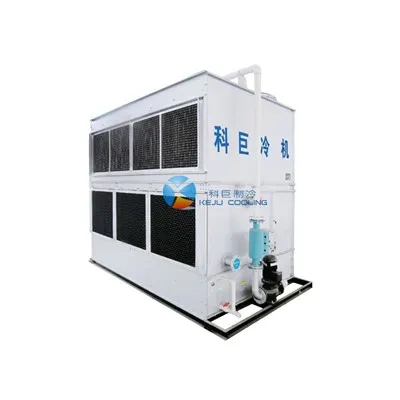
Closed cooling tower engineering design considerations
Oct 16, 2024
1. Air environment
FB series closed cooling towers must be supplied with sufficient fresh air at the air inlet. When the equipment is located close to the wall or in a confined space, it is necessary to take corresponding measures to ensure that the discharged high-temperature, saturated gas will not turn and flow directly to the air inlet.
For detailed information on the installation of closed coolers, please call our company, and a professional engineer will design it for you.
2. Fluid compatibility
The fluid to be cooled by the cooler must be compatible with the coil material. Fluids that are incompatible with the coil material will cause coil corrosion and pipe damage. Certain specific fluids may require pressure cleaning or mechanical cleaning of the inside of the coil from time to time. In this case, the supplied coil must have this capability in the design.
3. Piping process
The design and installation of the cooler pipeline should be in accordance with general engineering practice experience. In a system with multiple units, the pipeline layout should be symmetrical, and the pipeline size should be considered based on low flow rate and low pressure drop. A standard closed cooler should be equipped with an expansion tank so that the liquid can expand and release the air in the system. All connections should be made with properly designed pipe hooks and brackets, and no loads should be applied to the cooler connections. Pipe brackets should not be fixed to the cooler frame.
4. Noise requirements
All closed coolers provide acoustic rating data that can be used to calculate the sound pressure level of the cooler. When making such calculations, the designer must consider the influence of the specific geometric dimensions of the installation, as well as the distance and position between the cooler and the noise-sensitive area.
5. Coil freezing protection
When the ambient temperature is below freezing, industrial fluid cooling equipment will lose heat even if the circulating water pump and fan are not running. In the absence of heat load on the circulating fluid, coil freezing will occur even at full flow. To prevent this possible freezing problem, the available protection measures are very easy to choose. If the system allows, the best protection against coil freezing is to use antifreeze (available from our company).
6. Sink freezing protection
When the ambient temperature is below freezing, the water in the sink must be protected from freezing when the cooling equipment is shut down. Further anti-freezing protection should be provided, and the water in the water collection tank should be drained to an auxiliary remote water tank indoors, or auxiliary heating should be provided for the water in the water distribution tray through an immersion electric heater, steam heating coil, or hot water coil. All exposed water pipes and water supply lines that do not drain during shutdown should be insulated with electric heating tape.
7. Water treatment
The cooling tower water system is continuously circulated in the circulating cooling system. Due to the changes in water temperature and flow rate, the continuous evaporation of water, the concentration of various inorganic ions and organic matter, the influence of comprehensive factors such as sunlight, wind and rain, and the entry of dust and debris, the system pipes and equipment (heat exchangers) will produce a lot of scale and dirt (sludge), which will cause problems such as reduced heat exchange efficiency, pipe blockage, equipment corrosion (serious perforation and scrapping), and increased operation and repair costs.
Areas with poor water quality should pay special attention to the water treatment of the water circulation system. It is recommended to use the alkaline control method- use the alkaline water treatment method to control the pH value of the circulating cooling water system between 8-9.5. This area is the chemical passivation area of steel and copper, and the corrosion rate is relatively slow. From the chemical characteristics of the equipment materials, the water system equipment is placed in a protective medium. At the same time, the main reason is that our EL alkaline control agent has a strong anti-scaling function even if the pH value is above 10, while the anti-scaling function of most water treatment agents at present is significantly reduced above pH 8.5, so they cannot use the alkaline control method.
https://www.kejucooling.com/