The Development And Current Status Of Closed Cooling Tower Technology
Aug 02, 2024
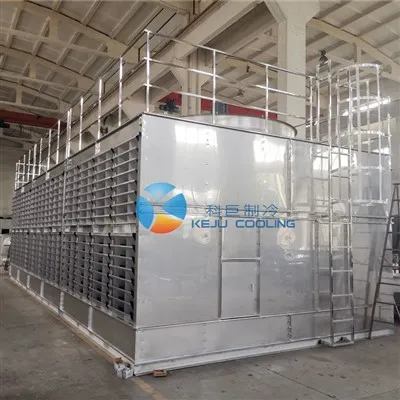
In an open cooling tower, the cooling water is in direct contact with the air, so after a period of use, the cooling water will be fouled and difficult to clean, which will cause the pipes to become clogged and the heat transfer effect of the equipment to decrease. A closed cooling tower can avoid this situation. The working fluid in the pipe does not come into direct contact with the air, keeping the working fluid clean.
The closed cooling tower originated from the evaporative cooler, which began in the middle of the last century. With the development of the chemical, metallurgical and electronic industries, it has gradually begun to be used. As early as 250 BC, the ancient Egyptians knew how to use water evaporation for cooling. In the last century, countries around the world also conducted multi-faceted research on evaporative cooling technology. In the 1970s, the emergence of the energy crisis made the application of evaporative cooling technology gradually gain attention. In the 1980s, when it was discovered that the catastrophic climate that posed a huge threat to human survival was related to the air conditioning and refrigeration industry, passive cooling technologies such as evaporative cooling technology that used natural conditions to obtain cooling capacity developed rapidly. For this purpose, the American ASHRAE established a technical committee called "Evaporative Cooling" to promote the application of evaporative cooling technology, collect and publish the application, installation, operation and maintenance data of evaporative cooling systems, publish specifications and standards, and affirm and reward research on evaporative cooling, so as to promote the application of evaporative cooling equipment around the world.
Parker and Treyball, based on ignoring the amount of water evaporated into the cooling air, assumed that the enthalpy of saturated air at room temperature is regarded as a linear function of temperature, and explained the heat transfer and mass transfer mechanism of the evaporative cooler from the heat transfer and mass transfer performance of the medium in the tube of the evaporative cooler, and obtained the correlation formula of the heat transfer film coefficient through experiments.
Mazushina proposed a calculation method for the thermal calculation of the evaporative cooler that can assume that the temperature of the spray water outside the tube is constant or that the temperature of the spray water film changes, and introduced a set of design calculation methods for heat exchangers in detail in the heat exchanger manual he compiled.
Webb unified the theoretical models of cooling towers, evaporative condensers and evaporative coolers, and the heat transfer coefficient of the water film and the mass transfer coefficient transferred to the air through the water film were expressed by different coefficients. Subsequently, Webb and Villacres used three algorithms and calculation models to describe and analyze cooling towers, fluid coolers, and evaporative condensers.
Peterson used numerical simulation to analyze indirect evaporative cooling, but the comparison between numerical simulation and experimental test data showed that the model had certain defects in accurately predicting system energy savings and system characteristics under some operating conditions. Under this condition, Peterson recommended using the correlation coefficient obtained from the test data to obtain the necessary design and characteristic basis.
Wo Jciech Zalewski proposed a mathematical model for water and air to cool the fluid in the coil in a countercurrent form, and obtained the mass transfer coefficient by using the analogy between heat transfer and mass transfer. Jorge Facao conducted a heat and mass transfer test on a small closed cooling tower, fitted the heat transfer process correlation, and the heat and mass transfer relationship obtained was consistent with the simplified theoretical model.
Some work has also been done in the research of evaporative cooling technology in China, including the study of evaporative cooling theory and the performance test of closed cooling towers.
Liu Nailing et al. studied the structural optimization of the tubular evaporative cooler of the closed cooling tower with the minimum heat exchange area and the minimum resistance as the constraint conditions, and analyzed the influence of structural parameters on the area of the tubular evaporative cooler and the energy consumption of the fan and water pump.
Li Zijun et al. took various countercurrent closed cooling tower heat exchange modules as the research object, analyzed the water temperature distribution under different conditions, and proposed a set of thermal calculation methods.
Liu Jing analyzed the heat exchange mechanism of the cooling process of the closed cooling tower, established a steady-state heat exchange model, and compiled a steady-state heat exchange simulation program based on the analytical solution results. The program was used to simulate the temperature and enthalpy distribution of the fluid inside the closed cooling tower. The theoretical calculation results of the outlet parameters of the fluid in the tower were compared with the measured data. The maximum error was within 9%, which proved the reliability of the result.
Zhao Fangping studied the cleaning and water quality treatment of the central air-conditioning cooling water system in the closed cooling tower to improve the heat exchange efficiency, prevent and reduce corrosion, and extend the service life of the air conditioner.
Niu Runping and others mainly studied the distribution of air enthalpy, moisture content, cooling water temperature, etc., and through the study of the internal heat exchange mechanism of the closed cooling tower, established a mathematical model and obtained an analytical solution to explore the influence of the closed cooling tower performance. Li Yongan and others used the small test bench they built to test the various performance indicators of the closed cooling tower for the air conditioning system. Through the simulation of the thermal performance of the closed cooling tower and the influence of parameters such as air inlet parameters, air mass flow, and spray water volume on the performance of the cooling tower, the air resistance calculation formula of the cooling coil was obtained.
Liu Dongxing and others analyzed the heat and mass exchange process between air and water, and established a mathematical model of heat and mass exchange of water-spraying packing in a countercurrent closed cooling tower on the basis of following the law of conservation of energy and conservation of matter. The model was solved by computer program using the iteration method and experimental verification was carried out. The research results show that the calculated values obtained by the mathematical model are compared with the experimental measurement values, and the deviation is within 0.25%.
Based on CFD software and the theory of countercurrent closed cooling tower, You Jiang et al. used the standard k-ε turbulence model for air flow motion, the discrete phase model for packing area, rain area and coil area, and the droplet flow approximation for the film flow in the packing area. The influence of water density and environmental conditions on the thermal characteristics of the cooling tower was simulated and analyzed, and the value of the dimensionless parameter air-water ratio that makes the cooling tower performance optimal was analyzed and obtained. The following conclusions were drawn: water density and environmental conditions have a great influence on the heat transfer effect of the countercurrent closed cooling tower. Zhou Wenyuan et al. proposed a new type of closed wet cooling tower. The cooling water and the spray water exchange heat through copper pipes, and plastic pipes are arranged in the cooling tower to increase the mass transfer area of air and spray water. The spray water and air exchange heat and mass on the surface of the copper pipe and the plastic pipe. Based on the one-dimensional transient mathematical model, the performance of the cooling tower under different operating conditions was investigated and compared with the traditional closed cooling tower, and the feasibility of this new closed wet cooling tower was concluded.