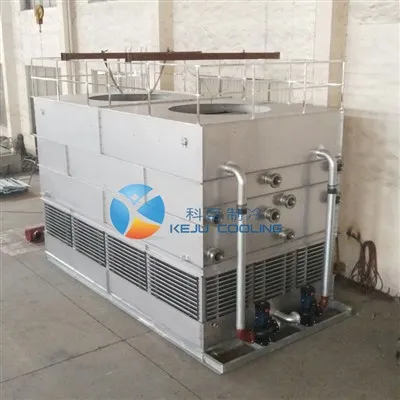
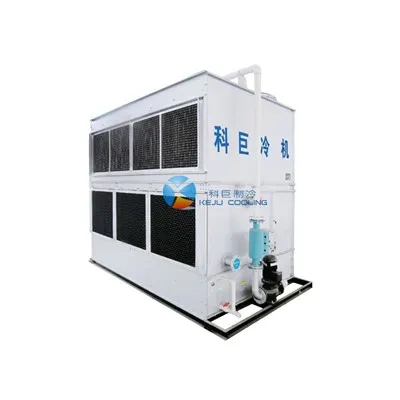
A New Type Of Central Air Inlet Countercurrent Closed Cooling Tower
Aug 03, 2024
Traditional countercurrent towers have many advantages, but they also have shortcomings such as small air flow section, small flow rate, and large flow resistance, which will affect the cooling effect. Therefore, if the air flow cross-sectional area can be increased in the countercurrent tower and the heat and mass transfer can be improved, then this countercurrent closed cooling tower will be a more competitive tower shape.
This structure is to arrange fillers at the top of the closed cooling tower and tube bundles at the bottom, and open air inlets on the two sides of the middle of the cooling tower. After the air enters the cooling tower from these two side air inlets, it is divided into two paths. One path flows upward through the fillers and is discharged from the top of the cooling tower, and the other path flows downward through the tube bundle, and then flows upward from the exhaust channel and is discharged from the top of the cooling tower. This exhaust channel is located on the two sides without air inlets. In the cooling tower, the spray water flows from top to bottom, and the fluid to be cooled in the tube bundle flows from bottom to top. In this way, the flow of air in the tube bundle is countercurrent to the flow of the cooled fluid in the tube, and the air in the filler is countercurrent to the spray water. This full countercurrent flow mode with air inlet in the middle and two-way flow up and down can increase the air circulation area, reduce the possibility of air backflow, increase the average temperature difference or enthalpy difference of heat and mass transfer between spray water and fluid, and between air and spray water, and maintain the kinetic potential energy of heat exchange in a reasonable range, thereby improving the heat and mass transfer effect, reducing the tube bundle area, and reducing costs. At the same time, the air and spray water in the coil area of this tower are set to flow in the same direction, which effectively prevents the occurrence of "air blocking" and overcomes the disadvantage of large resistance loss in ordinary reverse flow.