

What are the ventilation requirements for a Closed Type Counterflow Cooling Tower?
May 26, 2025
Ventilation is a critical factor in the efficient operation of a Closed Type Counterflow Cooling Tower. As a supplier of such cooling towers, I understand the importance of meeting the right ventilation requirements to ensure optimal performance, energy efficiency, and longevity of the equipment. In this blog, we will delve into the key ventilation requirements for a Closed Type Counterflow Cooling Tower and why they matter.
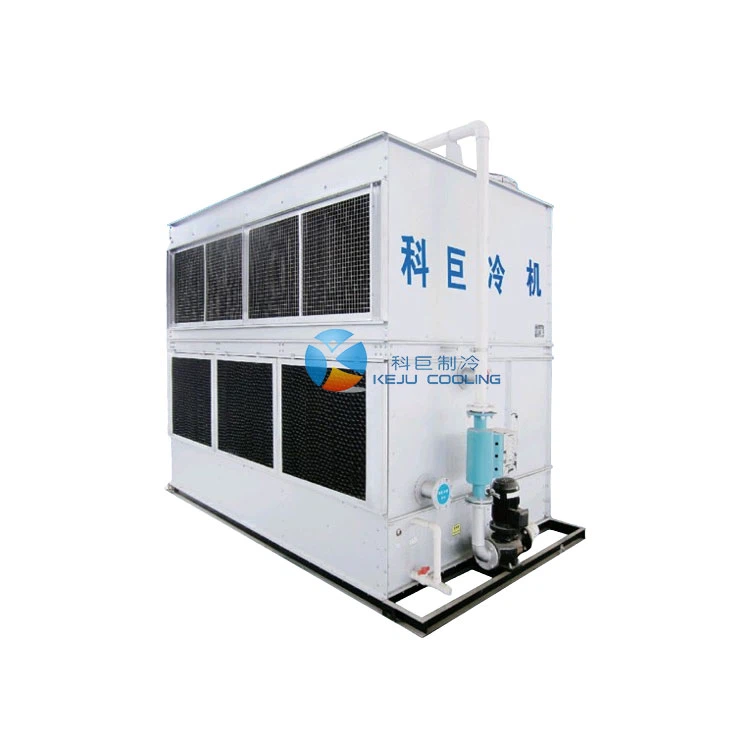

Understanding Closed Type Counterflow Cooling Towers
Before we discuss the ventilation requirements, let's briefly understand what a Closed Type Counterflow Cooling Tower is. In a counterflow cooling tower, the hot water flows downward through the fill media, while the air flows upward, creating a counter - current flow pattern. This design maximizes the contact between the water and the air, enhancing the heat transfer process. The closed - type feature means that the process fluid (usually water) is contained within a closed loop, separated from the external environment. This helps in preventing contamination and reducing water loss.
Importance of Ventilation
Ventilation in a Closed Type Counterflow Cooling Tower serves several crucial purposes. Firstly, it provides the necessary air supply for the evaporation process. As the hot water is exposed to the moving air, a portion of it evaporates, absorbing latent heat from the remaining water and thus cooling it down. Secondly, proper ventilation helps in removing the heat and moisture generated during the cooling process. Without adequate ventilation, the tower would experience a build - up of heat and humidity, which can lead to reduced cooling efficiency and potential damage to the equipment.
Key Ventilation Requirements
Airflow Rate
The airflow rate is one of the most important ventilation requirements. It is measured in cubic feet per minute (CFM) or cubic meters per hour (m³/h). The required airflow rate depends on several factors, including the heat load of the process, the design of the cooling tower, and the ambient conditions. A higher heat load will require a greater airflow rate to remove the excess heat. For example, in industrial applications where large amounts of heat are generated, such as power plants or manufacturing facilities, the cooling tower may need a significantly higher airflow rate compared to a smaller commercial building.
To calculate the required airflow rate, engineers typically use complex formulas that take into account the heat transfer rate, the specific heat of water, and the evaporation rate. However, as a general rule, a well - designed Closed Type Counterflow Cooling Tower should have an airflow rate that is sufficient to maintain a proper balance between the heat removal and the evaporation process.
Air Distribution
Uniform air distribution is equally important as the airflow rate. Uneven air distribution can lead to hot spots within the cooling tower, where the cooling efficiency is reduced. This can occur if the air intake or outlet is blocked, or if the internal structure of the tower restricts the flow of air.
To ensure uniform air distribution, the cooling tower should be designed with proper air intake and outlet configurations. The air intake should be located in a way that allows for unrestricted entry of fresh air. For example, it should be placed away from any obstructions such as walls or other equipment. The outlet should also be designed to allow for the efficient expulsion of the heated and moist air. Internal components such as the fill media and the mist eliminators should be arranged in a way that promotes even air flow throughout the tower.
Air Quality
The quality of the air entering the cooling tower is another important consideration. The air should be free from contaminants such as dust, dirt, and chemicals. Contaminants can accumulate on the fill media and other internal components of the cooling tower, reducing their effectiveness and increasing the risk of corrosion.
In some cases, air filtration systems may be required to ensure that the air entering the tower is clean. These filtration systems can range from simple mesh filters to more advanced high - efficiency particulate air (HEPA) filters, depending on the specific requirements of the application.
Ventilation System Design
The design of the ventilation system plays a crucial role in meeting the ventilation requirements. There are two main types of ventilation systems used in Closed Type Counterflow Cooling Towers: forced draft and induced draft.
In a forced draft system, the air is forced into the cooling tower by a fan located at the air intake. This type of system is often used in applications where the air needs to be pushed through a complex ductwork or where the tower is located in a confined space. However, forced draft systems can sometimes lead to uneven air distribution and may be more prone to recirculation of the heated air.
On the other hand, an Induced Draft Counter Flow Closed Cooling Tower uses a fan located at the air outlet to draw the air through the tower. This type of system generally provides better air distribution and reduces the risk of recirculation. It is also more energy - efficient in many cases, as the fan operates against a lower pressure.
Impact of Ventilation on Cooling Tower Performance
Proper ventilation has a direct impact on the performance of a Closed Type Counterflow Cooling Tower. When the ventilation requirements are met, the cooling tower can operate at its maximum efficiency, providing the desired cooling capacity with minimal energy consumption.
For example, a well - ventilated cooling tower can achieve a lower approach temperature (the difference between the outlet water temperature and the wet - bulb temperature of the ambient air). A lower approach temperature means that the cooling tower is more efficient at removing heat from the process fluid. Additionally, proper ventilation helps in reducing the scaling and fouling of the internal components, which can extend the lifespan of the cooling tower and reduce maintenance costs.
Meeting Ventilation Requirements in Different Applications
The ventilation requirements may vary depending on the specific application of the Closed Type Counterflow Cooling Tower. In industrial applications, where the heat load is high and the operating conditions are more demanding, the cooling tower may require a more robust ventilation system. This could include larger fans, more advanced air distribution systems, and higher - capacity air filtration.
In commercial applications, such as office buildings or hotels, the cooling tower may be smaller and the ventilation requirements may be less stringent. However, it is still important to ensure that the ventilation system is properly designed and maintained to provide efficient cooling and prevent any potential issues.
Conclusion
In conclusion, ventilation is a critical aspect of the operation of a Closed Type Counterflow Cooling Tower. Meeting the right ventilation requirements, including airflow rate, air distribution, air quality, and ventilation system design, is essential for ensuring optimal performance, energy efficiency, and longevity of the cooling tower.
As a supplier of Counter Flow Closed Circuit Cooling Tower and Counter Flow Closed Type Cooling Tower, we are committed to providing high - quality cooling towers that meet the specific ventilation requirements of our customers. If you are in the market for a Closed Type Counterflow Cooling Tower or need to upgrade your existing system, we invite you to contact us for a consultation. Our team of experts will work with you to understand your needs and provide the best solution for your application.
References
- ASHRAE Handbook - HVAC Systems and Equipment. American Society of Heating, Refrigerating and Air - Conditioning Engineers.
- Cooling Tower Institute (CTI) Standards. Cooling Tower Institute.
- Incropera, F. P., & DeWitt, D. P. (2002). Fundamentals of Heat and Mass Transfer. John Wiley & Sons.