

How to select the appropriate size of a cross flow open loop cooling tower?
Nov 11, 2025
Hey there! As a supplier of Cross Flow Open Loop Cooling Towers, I often get asked about how to select the appropriate size for these cooling towers. It's a crucial decision, as getting the size right can significantly impact the efficiency and effectiveness of your cooling system. So, let's dive into the key factors you need to consider when making this important choice.
Understanding the Basics
First off, let's quickly go over what a cross flow open loop cooling tower is. In a cross flow design, the air flows horizontally across the direction of the falling water. The open loop means that the water being cooled is in direct contact with the atmosphere. This type of cooling tower is widely used in various industries, such as power generation, manufacturing, and HVAC systems.
Heat Load Calculation
The most fundamental factor in determining the size of a cooling tower is the heat load. The heat load is the amount of heat that the cooling tower needs to remove from the system. You can calculate the heat load using the following formula:
[Q = m \times C_p \times \Delta T]
Where:
- (Q) is the heat load (in BTU/hr or kW)
- (m) is the mass flow rate of the water (in lb/hr or kg/s)
- (C_p) is the specific heat capacity of water (1 BTU/lb°F or 4.18 kJ/kg°C)
- (\Delta T) is the temperature difference between the inlet and outlet water (in °F or °C)
For example, if you have a water flow rate of 1000 lb/hr, a specific heat capacity of 1 BTU/lb°F, and a temperature difference of 10°F, the heat load would be:
[Q = 1000 \text{ lb/hr} \times 1 \text{ BTU/lb°F} \times 10°F = 10,000 \text{ BTU/hr}]
Once you have calculated the heat load, you can use it to select a cooling tower with the appropriate capacity. Most cooling tower manufacturers provide performance curves that show the relationship between the heat load, water flow rate, and cooling tower size.
Water Flow Rate
The water flow rate is another important factor to consider. It refers to the amount of water that passes through the cooling tower per unit of time. The water flow rate affects the cooling tower's ability to transfer heat and maintain the desired temperature.
To determine the required water flow rate, you need to know the heat load and the temperature difference. You can use the same formula as above, but rearrange it to solve for (m):
[m = \frac{Q}{C_p \times \Delta T}]
For example, if you have a heat load of 10,000 BTU/hr, a specific heat capacity of 1 BTU/lb°F, and a temperature difference of 10°F, the required water flow rate would be:
[m = \frac{10,000 \text{ BTU/hr}}{1 \text{ BTU/lb°F} \times 10°F} = 1000 \text{ lb/hr}]
It's important to note that the water flow rate should be within the recommended range for the cooling tower. If the flow rate is too high, the water may not have enough time to cool properly, and if it's too low, the cooling tower may not be able to handle the heat load.
Approach and Range
The approach and range are two important parameters that describe the performance of a cooling tower. The approach is the difference between the outlet water temperature and the wet-bulb temperature of the air. The range is the difference between the inlet and outlet water temperatures.
A lower approach indicates better cooling performance, as it means that the water is being cooled closer to the wet-bulb temperature. A higher range means that the cooling tower is removing more heat from the water.
When selecting a cooling tower, you need to consider the required approach and range for your application. Most industrial applications require an approach of 5°F to 10°F and a range of 10°F to 20°F.
Ambient Conditions
The ambient conditions, such as the temperature and humidity of the air, can also affect the performance of a cooling tower. In general, a cooling tower will perform better in cooler and drier conditions.
When selecting a cooling tower, you need to consider the worst-case ambient conditions that your system will experience. You can use the wet-bulb temperature of the air as a reference point, as it takes into account both the temperature and humidity of the air.
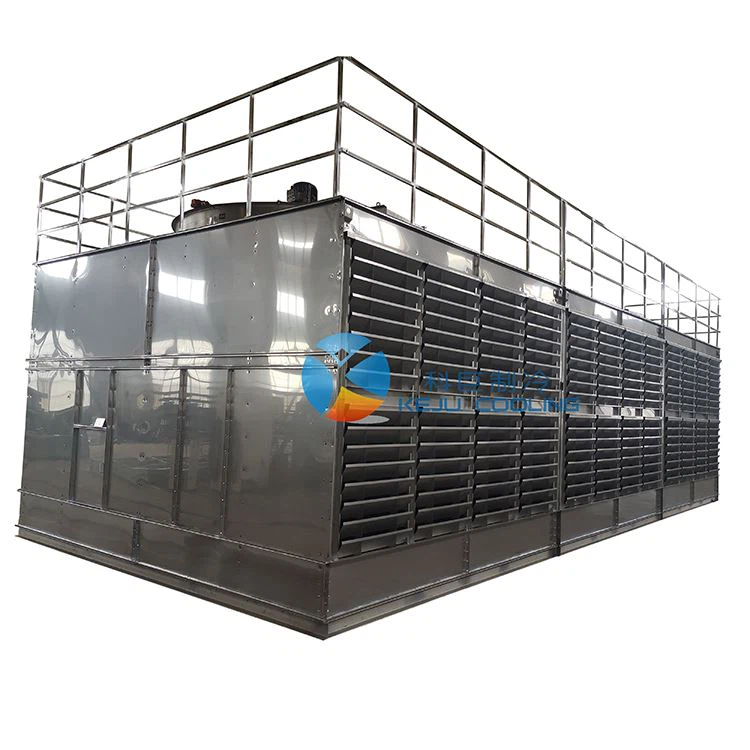

Most cooling tower manufacturers provide performance curves that show the relationship between the heat load, water flow rate, approach, range, and ambient conditions. You can use these curves to select a cooling tower that will perform well under your specific conditions.
Tower Type and Configuration
There are different types and configurations of cross flow open loop cooling towers available, each with its own advantages and disadvantages. Some of the common types include:
- Open Circuit Evaporative Cooling Tower: This type of cooling tower uses evaporation to remove heat from the water. It is the most common type of cooling tower and is suitable for a wide range of applications.
- Cross Flow Steel Open Cooling Tower: This type of cooling tower is made of steel and is designed for heavy-duty applications. It is more durable and resistant to corrosion than other types of cooling towers.
- Crossflow Open Type Cooling Tower: This type of cooling tower has an open design, which allows for easy access and maintenance. It is suitable for applications where space is limited.
When selecting a cooling tower, you need to consider the specific requirements of your application, such as the heat load, water flow rate, ambient conditions, and available space. You also need to consider the cost, reliability, and maintenance requirements of the cooling tower.
Maintenance and Operation
Finally, you need to consider the maintenance and operation requirements of a cooling tower. A well-maintained cooling tower will perform better and last longer than a poorly maintained one.
Some of the common maintenance tasks for a cooling tower include:
- Regular cleaning of the fill material to prevent clogging
- Inspection and maintenance of the fans and motors
- Monitoring and adjusting the water chemistry to prevent corrosion and scaling
- Checking the water level and flow rate
- Inspecting the tower structure for any signs of damage
When selecting a cooling tower, you need to consider the ease of maintenance and the availability of replacement parts. You also need to ensure that your staff is trained to operate and maintain the cooling tower properly.
Conclusion
Selecting the appropriate size of a cross flow open loop cooling tower is a critical decision that requires careful consideration of several factors, including the heat load, water flow rate, approach, range, ambient conditions, tower type and configuration, and maintenance and operation requirements.
By following the guidelines outlined in this blog post, you can ensure that you select a cooling tower that will meet the needs of your application and provide reliable and efficient cooling for your system.
If you have any questions or need further assistance with selecting a cooling tower, please don't hesitate to contact us. We're here to help you make the right choice for your cooling needs.
References
- Cooling Tower Institute. (2023). Cooling Tower Handbook.
- ASHRAE. (2023). Handbook of Fundamentals.