

How does a counter flow closed water cooling tower reduce water evaporation?
Jul 15, 2025
Hey there! As a supplier of Counter Flow Closed Water Cooling Towers, I often get asked about how these nifty devices manage to reduce water evaporation. So, I thought I'd take a deep dive into this topic and share all the juicy details with you.
First off, let's understand what a counter flow closed water cooling tower is. In simple terms, it's a type of cooling tower where the hot water flows downwards while the air flows upwards in a counter - current direction. And the "closed" part means that the process water is contained within a closed circuit, separated from the ambient air and the external water spray system. You can learn more about different types of these towers on our website: Counter Flow Closed Type Cooling Tower, Counter Flow Closed Loop Cooling Tower, and Counterflow Closed Circuit Cooling Tower.
Now, onto the main question - how does it reduce water evaporation?
1. Closed Circuit Design
The most significant factor is the closed - circuit design. In an open cooling tower, the process water is directly exposed to the atmosphere. As the air passes through the open tower, it picks up a large amount of water vapor, leading to substantial evaporation. But in a counter flow closed water cooling tower, the process water is kept inside a series of tubes or coils. This means that the water doesn't come into direct contact with the outside air.
The only water that is exposed to the air is the external water used for the cooling process. This external water is sprayed over the outside of the tubes or coils to absorb heat from the process water inside. Since the volume of this external water is much smaller compared to the total process water, the amount of evaporation is also significantly reduced.
2. Counter - Flow Principle
The counter - flow design plays a crucial role in reducing evaporation. When the hot process water flows downwards and the cool air flows upwards, it creates an efficient heat - transfer mechanism. The air entering the tower is at its coolest at the bottom, where the water is also at its coolest after being cooled by the heat exchange. As the air moves upwards, it gradually warms up while absorbing heat from the water.
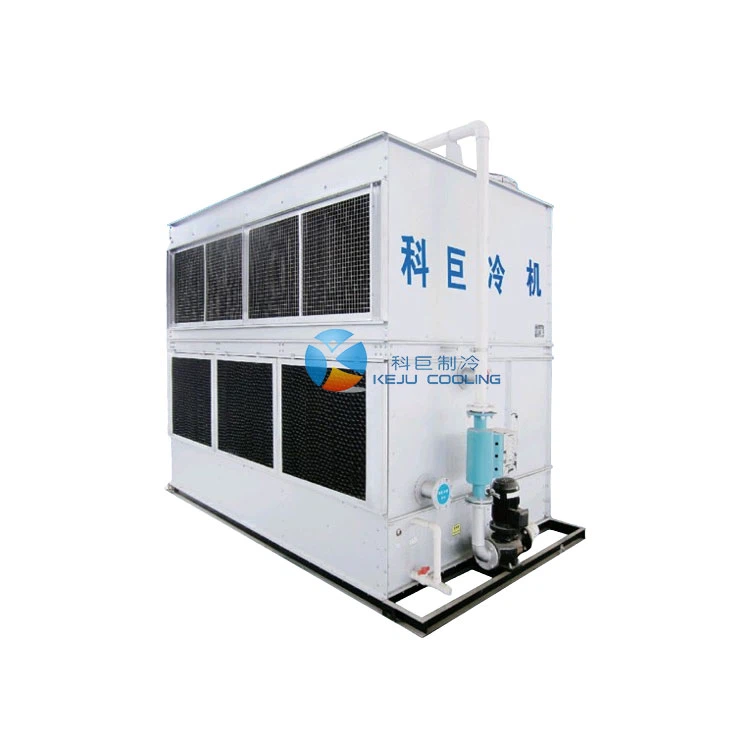

This counter - flow arrangement allows for maximum heat transfer with a relatively small temperature difference between the air and the water at any given point. Since the heat transfer is more efficient, less water needs to be evaporated to achieve the desired cooling effect. In other words, the tower can cool the water effectively without relying too much on the evaporation of water.
3. Evaporation Control with Drift Eliminators
Drift eliminators are an essential component of a counter flow closed water cooling tower. These are devices installed at the top of the tower to capture water droplets that are carried along with the rising air. When the air exits the tower, it often contains small water droplets. If these droplets are not captured, they will be lost to the atmosphere, contributing to water evaporation.
Drift eliminators work by forcing the air to change direction multiple times. As the air changes direction, the water droplets collide with the surfaces of the drift eliminator and coalesce into larger droplets. These larger droplets then fall back into the tower, reducing the amount of water lost through drift. This helps in further minimizing water evaporation.
4. Precise Water Management
We, as suppliers, ensure that our counter flow closed water cooling towers are equipped with advanced water management systems. These systems monitor and control the water levels, flow rates, and temperatures inside the tower.
For example, the water spray system can be adjusted based on the actual cooling requirements. If the cooling load is low, the amount of water sprayed can be reduced, which in turn reduces the potential for evaporation. Additionally, the make - up water supply can be precisely regulated to replace only the water that is actually lost due to evaporation and drift. This prevents over - filling of the tower and unnecessary water loss.
5. Heat Exchanger Efficiency
The heat exchangers used in counter flow closed water cooling towers are designed to be highly efficient. These heat exchangers are responsible for transferring the heat from the process water to the external water and then to the air. A more efficient heat exchanger can transfer heat with less water evaporation.
The materials and design of the heat exchangers are carefully chosen to maximize the surface area available for heat transfer. This allows for a greater amount of heat to be transferred without having to rely on excessive evaporation. For instance, some heat exchangers use finned tubes, which increase the surface area and enhance the heat - transfer efficiency.
Benefits of Reduced Water Evaporation
Reducing water evaporation in a counter flow closed water cooling tower has several benefits. Firstly, it means significant cost savings on water consumption. In areas where water is scarce or expensive, this can be a major advantage. Secondly, it helps in environmental conservation by reducing the demand for fresh water.
Moreover, less water evaporation also means less scaling and corrosion inside the tower. When water evaporates, it leaves behind dissolved solids, which can cause scaling on the surfaces of the tower components. By reducing evaporation, the amount of these solids deposited is also reduced, leading to less maintenance and a longer lifespan for the tower.
Why Choose Our Counter Flow Closed Water Cooling Towers
As a supplier, we take pride in offering high - quality counter flow closed water cooling towers that are designed to minimize water evaporation. Our towers are built with the latest technology and the best materials to ensure maximum efficiency and reliability.
We understand that every customer has unique cooling requirements, and we offer customized solutions to meet those needs. Whether you need a small tower for a local business or a large - scale tower for an industrial plant, we've got you covered.
If you're interested in learning more about our counter flow closed water cooling towers or are looking to make a purchase, we'd love to hear from you. We can provide you with detailed information about our products, including specifications, pricing, and installation services. Contact us today, and let's start a conversation about how our cooling towers can help you save water and money while keeping your operations cool.
References
- Cooling Tower Institute. (n.d.). Cooling Tower Fundamentals.
- ASHRAE Handbook. (n.d.). HVAC Systems and Equipment.