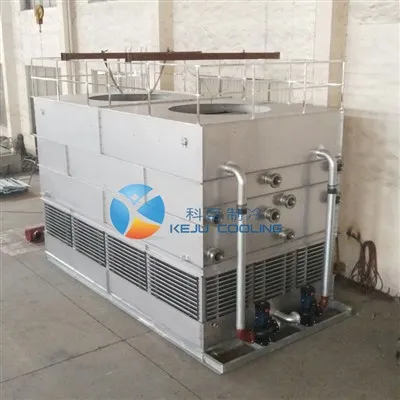
How Cooling Towers Work
Aug 07, 2024
Cooling tower is a kind of equipment that uses the contact between water and air to dissipate the waste heat generated in industry or refrigeration and air conditioning through evaporation.
The basic principle is: dry (low enthalpy) air enters the cooling tower from the air inlet after being pumped by the fan; saturated steam and high-pressure high-temperature water molecules flow to the low-pressure air, and wet and hot (high enthalpy) water is sprinkled into the tower from the water-spreading system. When water droplets come into contact with air, on the one hand, due to the direct heat transfer between air and water, on the other hand, due to the pressure difference between the surface of water vapor and air, evaporation occurs under the action of pressure, and the heat in the water is taken away by evaporation heat transfer, thereby achieving the purpose of cooling.
The working process of the cooling tower: Take the working process of the circular countercurrent cooling tower as an example: hot water is pumped from the main room through the pipe, horizontal throat, curved throat, and center throat at a certain pressure to press the circulating water into the cooling tower's water-spreading system, and the water is evenly spread on the filler through the small holes on the water-spreading pipe. Dry air with low wet bulb temperature enters the tower from the bottom air inlet net under the action of the fan. When hot water flows through the surface of the filler, it forms a water film and exchanges heat with the air. The hot air with high humidity and high wet bulb temperature is extracted from the top. The air entering the tower is dry air with low wet bulb temperature. There is obviously a concentration difference and kinetic pressure difference between water molecules and air. When the fan is running, under the action of the static pressure in the tower, water molecules continue to evaporate into the air and become water vapor molecules. The average kinetic energy of the remaining water molecules will decrease, thereby reducing the temperature of the circulating water. From the above analysis, it can be seen that evaporative cooling has nothing to do with the air temperature (usually the dry bulb temperature) being lower or higher than the water temperature. As long as the water molecules can continue to evaporate into the air, the water temperature will decrease. However, the evaporation of water into the air will not continue endlessly. When the air in contact with water is not saturated, water molecules continue to evaporate into the air, but when the air on the water vapor contact surface reaches saturation, the water molecules cannot evaporate out, but are in a dynamic equilibrium state. The number of water molecules evaporated is equal to the number of water molecules returned from the air to the water, and the water temperature remains unchanged. From this we can see that the drier the air that comes into contact with water, the easier it is for evaporation to take place and the easier it is for the water temperature to drop.