

What is the evaporation rate in a steel open water cooling tower?
Jul 24, 2025
The evaporation rate in a steel open water cooling tower is a crucial parameter that directly impacts the efficiency and operational cost of the cooling system. As a leading supplier of steel open water cooling towers, we understand the significance of this factor and are committed to providing in - depth knowledge to our customers.
Understanding the Basics of Evaporation in Cooling Towers
Evaporation is a natural process where a liquid changes into a vapor state. In a steel open water cooling tower, water is sprayed or distributed over a fill media, which provides a large surface area for the water to come into contact with the air. As the air passes through the tower, it picks up heat and moisture from the water, causing a portion of the water to evaporate. This evaporation process is what removes heat from the water, cooling it down for reuse in industrial processes or HVAC systems.
The evaporation rate is typically measured in terms of the mass or volume of water evaporated per unit of time. It is influenced by several factors, including the temperature and humidity of the incoming air, the flow rate of the water and air through the tower, and the design and efficiency of the cooling tower itself.
Factors Affecting the Evaporation Rate
Air Temperature and Humidity
The temperature and humidity of the incoming air play a significant role in determining the evaporation rate. Warmer air can hold more moisture than cooler air, so higher air temperatures generally lead to a higher evaporation rate. Conversely, if the air is already saturated with moisture (high humidity), the evaporation rate will be lower because there is less capacity for the air to take on additional water vapor.
For example, in a hot and dry climate, the evaporation rate in a steel open water cooling tower can be relatively high. The dry air has a large capacity to absorb moisture, and the heat from the air helps to facilitate the evaporation process. On the other hand, in a humid climate, the evaporation rate may be limited, and additional measures may be required to enhance the cooling efficiency of the tower.
Water and Air Flow Rates
The flow rates of water and air through the cooling tower also have a direct impact on the evaporation rate. A higher water flow rate means that more water is available for evaporation, but if the air flow rate is not sufficient to carry away the evaporated water vapor, the evaporation rate may be restricted. Similarly, if the air flow rate is too high, it may cause the water to be carried out of the tower without being fully evaporated, leading to water loss and reduced cooling efficiency.
Optimal water and air flow rates need to be carefully balanced to achieve the highest possible evaporation rate. This requires a well - designed cooling tower that can ensure proper distribution of water and air throughout the tower. Our Square Crossflow Open Circuit Cooling Tower is engineered to provide efficient water and air distribution, maximizing the evaporation rate while minimizing water loss.
Cooling Tower Design
The design of the cooling tower, including the type of fill media, the tower configuration, and the size of the tower, can significantly affect the evaporation rate. The fill media provides the surface area for the water - air contact, and different types of fill media have different surface areas and wetting characteristics. A fill media with a large surface area and good wetting properties will enhance the evaporation rate by increasing the contact between the water and the air.
There are different types of cooling tower configurations, such as cross - flow and counter - flow designs. Cross - flow cooling towers, like our Cross Flow Open Loop Cooling Tower, allow the air to flow horizontally across the water flow, providing a large contact area between the water and the air. This design can be very effective in promoting evaporation.
Calculating the Evaporation Rate
The evaporation rate in a steel open water cooling tower can be calculated using various methods. One common approach is based on the heat transfer principles. The heat removed from the water through evaporation is equal to the latent heat of vaporization of water multiplied by the mass of water evaporated.
The formula for calculating the evaporation rate (E) in kg/s is given by:
[E=\frac{Q}{h_{fg}}]
where (Q) is the heat removed from the water (in W) and (h_{fg}) is the latent heat of vaporization of water (in J/kg). The heat removed from the water can be calculated based on the mass flow rate of the water ((m_w)), the specific heat capacity of water ((c_p)), and the temperature difference between the inlet and outlet water ((\Delta T)):
[Q = m_w\times c_p\times\Delta T]
However, in practical applications, the calculation of the evaporation rate can be more complex due to the influence of other factors such as air humidity, water quality, and the efficiency of the cooling tower.
Importance of Controlling the Evaporation Rate
Controlling the evaporation rate in a steel open water cooling tower is essential for several reasons. Firstly, it helps to optimize the cooling efficiency of the tower. By maintaining an appropriate evaporation rate, the tower can effectively remove heat from the water, ensuring that the cooled water can meet the requirements of the industrial process or HVAC system.
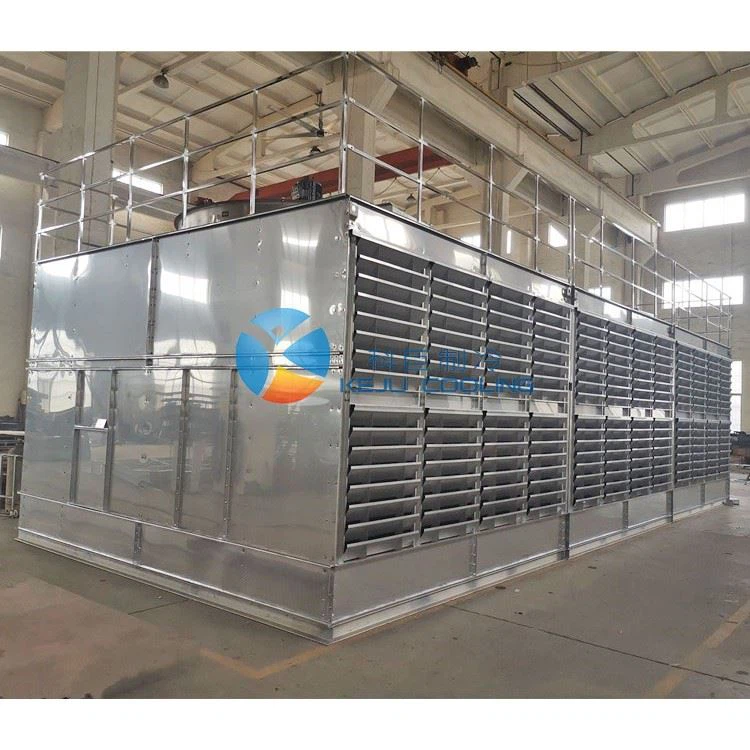

Secondly, controlling the evaporation rate can reduce water consumption. Evaporation is a necessary process for cooling, but excessive evaporation can lead to significant water loss. This not only increases the cost of water supply but also has environmental implications. Our Square Cross Flow Open Cooling Tower is designed to provide a balance between evaporation and water conservation, helping our customers to reduce their water usage.
Our Solutions for Optimizing the Evaporation Rate
As a professional supplier of steel open water cooling towers, we offer a range of products and services to help our customers optimize the evaporation rate in their cooling systems. Our cooling towers are designed with high - quality fill media and advanced water and air distribution systems to ensure efficient evaporation.
We also provide customized solutions based on the specific requirements of our customers. Our team of experts can conduct on - site inspections and analyses to determine the optimal operating conditions for the cooling tower, including the water and air flow rates, the temperature and humidity of the incoming air, and the chemical treatment of the water.
In addition, we offer after - sales services such as maintenance, repair, and upgrade of the cooling towers. Regular maintenance can ensure that the cooling tower operates at its peak efficiency, maintaining a stable evaporation rate over time.
Conclusion
The evaporation rate in a steel open water cooling tower is a complex parameter that is influenced by multiple factors. Understanding these factors and how to control the evaporation rate is crucial for the efficient operation of the cooling system. As a leading supplier of steel open water cooling towers, we are dedicated to providing our customers with high - quality products and professional services to help them optimize the evaporation rate in their cooling systems.
If you are interested in learning more about our steel open water cooling towers or need assistance in optimizing the evaporation rate in your cooling system, please feel free to contact us. Our team of experts is ready to discuss your specific needs and provide you with the best solutions.
References
- ASHRAE Handbook - HVAC Systems and Equipment. American Society of Heating, Refrigerating and Air - Conditioning Engineers.
- Cooling Tower Institute (CTI) Standards and Guidelines. Cooling Tower Institute.
- Stoecker, W. F. and Jones, J. W. "Refrigeration and Air Conditioning". McGraw - Hill Education.