

What is the difference between a cross flow open loop cooling tower and a closed - loop cooling tower?
Dec 11, 2025
What is the Difference between a Cross Flow Open Loop Cooling Tower and a Closed - Loop Cooling Tower?
As a supplier of Cross Flow Open Loop Cooling Towers, I often encounter customers who are unsure about the differences between cross flow open loop cooling towers and closed - loop cooling towers. In this blog post, I aim to provide a comprehensive understanding of these two types of cooling towers, their unique features, advantages, and disadvantages, and help you make an informed decision about which one is the best fit for your needs.
Understanding Cross Flow Open Loop Cooling Towers
A cross flow open loop cooling tower is a type of cooling system that uses the principle of evaporative cooling to remove heat from a process or equipment. In a cross flow design, the air flows horizontally across the water flow, which is vertically downward. This design allows for a more efficient heat transfer process.
The open - loop nature of these cooling towers means that the process water is directly exposed to the atmosphere. The water is typically sprayed over a fill material, which provides a large surface area for the air - water contact. As the air passes through the fill, a small portion of the water evaporates, absorbing heat from the remaining water. This evaporated water is then carried away by the air, and the cooled water is collected at the bottom of the tower and recirculated back to the process.
Some of the key features of cross flow open loop cooling towers include:
- Efficient Heat Transfer: The cross flow design allows for a large contact area between the air and water, resulting in efficient heat dissipation.
- Cost - Effective: Open loop systems generally have a lower initial cost compared to closed - loop systems. They also have lower operating costs in terms of energy consumption, as they rely on natural evaporation for cooling.
- Easy Maintenance: The open nature of the system makes it easier to access and maintain components such as the fill, nozzles, and basins.
Here are some of our cross flow open loop cooling tower products you can explore: Open Circuit Evaporative Cooling Tower, Open Circuit Cross Flow Square Cooling Tower, and Cross Flow Steel Open Cooling Tower.
Understanding Closed - Loop Cooling Towers
A closed - loop cooling tower, on the other hand, is a system where the process fluid is contained within a closed circuit. The heat is transferred from the process fluid to a secondary fluid (usually water) through a heat exchanger. The secondary fluid is then cooled in the cooling tower using the same evaporative cooling principle as in an open - loop system.
In a closed - loop system, the process fluid never comes into direct contact with the atmosphere. This is especially important when the process fluid is expensive, corrosive, or contains contaminants that should not be released into the environment.
The main features of closed - loop cooling towers are:
- Fluid Protection: Since the process fluid is in a closed circuit, it is protected from contamination, evaporation, and corrosion. This can extend the lifespan of the process equipment and the fluid itself.
- Environmental Compliance: Closed - loop systems are more environmentally friendly as they prevent the release of potentially harmful substances into the atmosphere.
- Higher Initial Cost: The addition of a heat exchanger and the need for a more complex design make closed - loop cooling towers more expensive to purchase and install compared to open - loop systems.
Key Differences between Cross Flow Open Loop Cooling Towers and Closed - Loop Cooling Towers
-
Water Contact with Process Fluid
- In a cross flow open loop cooling tower, the process water is directly exposed to the air, which means it can be contaminated by dust, dirt, and other atmospheric pollutants. This requires regular water treatment to prevent scaling, corrosion, and biological growth.
- In a closed - loop cooling tower, the process fluid is isolated from the atmosphere, reducing the risk of contamination and the need for extensive water treatment.
-
Heat Transfer Mechanism
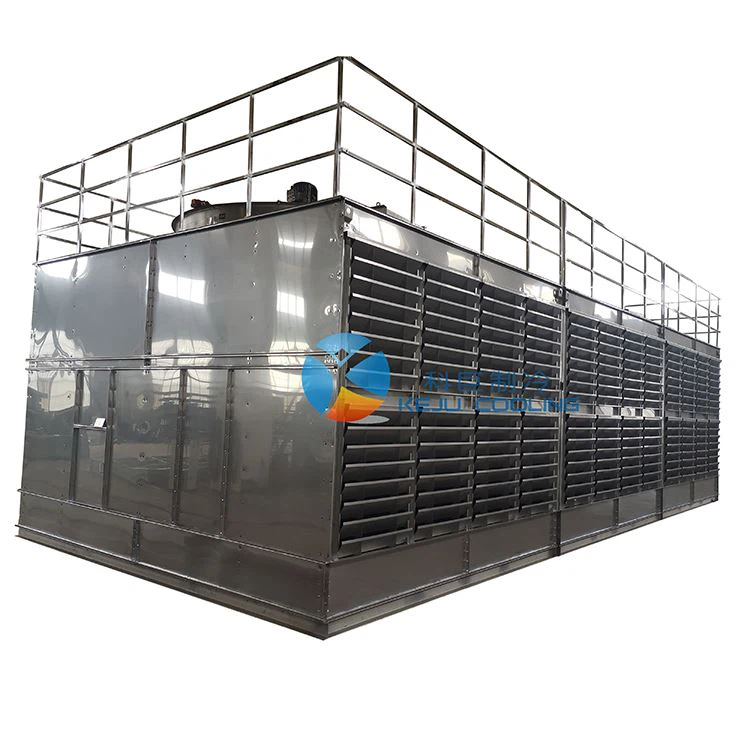

- Cross flow open loop cooling towers rely on direct evaporative cooling, where a portion of the water evaporates to remove heat.
- Closed - loop cooling towers use an indirect heat transfer method through a heat exchanger. The primary heat transfer is from the process fluid to the secondary fluid, and then the secondary fluid is cooled by evaporation.
-
Energy and Water Consumption
- Open loop systems typically have lower energy consumption since they rely more on natural evaporation. However, they do have higher water consumption due to evaporation losses.
- Closed - loop systems can have higher energy consumption because of the additional pumping required for the heat exchanger. But they generally have lower water consumption as the process fluid is recycled within the closed circuit.
-
Maintenance Requirements
- Open loop cooling towers require more frequent maintenance to clean the fill, nozzles, and basins to prevent clogging and fouling. They also need regular water quality monitoring and treatment.
- Closed - loop cooling towers have less maintenance in terms of water treatment and protection from external contaminants. However, the heat exchanger may require periodic maintenance to ensure efficient heat transfer.
Which Type of Cooling Tower is Right for You?
The choice between a cross flow open loop cooling tower and a closed - loop cooling tower depends on several factors:
- Nature of the Process Fluid: If the process fluid is sensitive, expensive, or contains hazardous substances, a closed - loop cooling tower is a better choice. For less sensitive applications, an open loop system can be more cost - effective.
- Environmental Considerations: If environmental regulations are strict or if you want to minimize the impact on the surrounding environment, a closed - loop system is preferred.
- Cost Constraints: If you have a limited budget for the initial purchase and installation of the cooling tower, a cross flow open loop cooling tower may be the more suitable option.
As a supplier of Cross Flow Open Loop Cooling Towers, I have witnessed firsthand the efficiency and reliability of these systems in various industrial and commercial applications. Our products are designed to deliver optimal performance and energy savings while ensuring ease of maintenance.
If you are in the market for a cooling tower and are still unsure which type is the best fit for your requirements, I encourage you to reach out to us. Our team of experts can provide you with detailed information, technical specifications, and customized solutions based on your specific needs. Whether you choose a cross flow open loop cooling tower or a closed - loop system, we are committed to helping you make an informed decision and ensuring the success of your project. Start the conversation today and let's find the perfect cooling solution for you.
References
- Cooling Tower Institute. (Year). Cooling Tower Handbook.
- ASHRAE. (Year). Handbook of HVAC Systems and Equipment.