

What are the factors affecting the evaporation efficiency in a steel open water cooling tower?
Jun 16, 2025
Hey there! As a supplier of Steel Open Water Cooling Towers, I've had my fair share of experiences and insights into the factors that affect evaporation efficiency in these cooling towers. So, let's dive right in and explore what makes these towers tick when it comes to evaporation.
1. Water Temperature
One of the most obvious factors is the temperature of the water entering the cooling tower. The higher the water temperature, the greater the driving force for evaporation. Think about it like this: when you heat up a pot of water on the stove, it evaporates faster than when it's at room temperature. In a steel open water cooling tower, hot water is distributed over the fill media. The heat from the water causes the water molecules to gain energy and turn into vapor more readily.
For instance, if the incoming water temperature is around 50°C, it will evaporate more quickly compared to water at 30°C. However, there's a catch. If the water temperature is too high, it can cause scaling and corrosion inside the tower, which can reduce its overall efficiency over time. So, it's a bit of a balancing act to maintain an optimal water temperature for efficient evaporation.
2. Airflow
Airflow plays a crucial role in the evaporation process. When air passes through the cooling tower, it picks up the water vapor, allowing more evaporation to occur. There are two main types of airflow in cooling towers: cross - flow and counter - flow.
In a Cross Flow Steel Open Cooling Tower, the air flows horizontally across the falling water. This design allows for a relatively large amount of air to come into contact with the water, promoting evaporation. On the other hand, in a counter - flow tower, the air flows in the opposite direction of the falling water. This can create a more efficient heat transfer, but it also requires more energy to move the air against the water flow.
The amount of airflow is also important. If the airflow is too low, the air will quickly become saturated with water vapor, and evaporation will slow down. Conversely, if the airflow is too high, it can cause excessive water drift, which is not only wasteful but can also lead to environmental issues. So, proper fan sizing and control are essential to maintain the right amount of airflow for efficient evaporation.
3. Fill Media
The fill media in a steel open water cooling tower is like the heart of the evaporation process. It provides a large surface area for the water to spread out, increasing the contact between the water and the air. There are different types of fill media, such as splash fill and film fill.
Splash fill consists of a series of bars or grids that break up the water into small droplets as it falls. This increases the surface area of the water exposed to the air, enhancing evaporation. Film fill, on the other hand, is made of thin sheets that allow the water to form a thin film as it flows down. This film provides an even larger surface area for evaporation.
The quality and design of the fill media can significantly affect evaporation efficiency. For example, if the fill media is clogged with dirt, debris, or biological growth, it can reduce the surface area available for evaporation and impede airflow. Regular maintenance and cleaning of the fill media are necessary to ensure optimal performance.
4. Humidity
The humidity of the surrounding air is another important factor. Evaporation occurs when there is a difference in the water vapor pressure between the water surface and the air. If the air is already saturated with water vapor (high humidity), there is less of a driving force for evaporation.
In areas with high humidity, the evaporation efficiency of a steel open water cooling tower can be significantly reduced. To counteract this, some cooling towers are equipped with dehumidification systems or are designed to operate at higher airflows to increase the rate of evaporation. However, these solutions can add to the cost and complexity of the system.
5. Tower Design
The overall design of the steel open water cooling tower also affects evaporation efficiency. For example, the shape and size of the tower can influence the airflow patterns inside. A well - designed tower will have a uniform distribution of water and air, ensuring that all parts of the fill media are effectively used for evaporation.

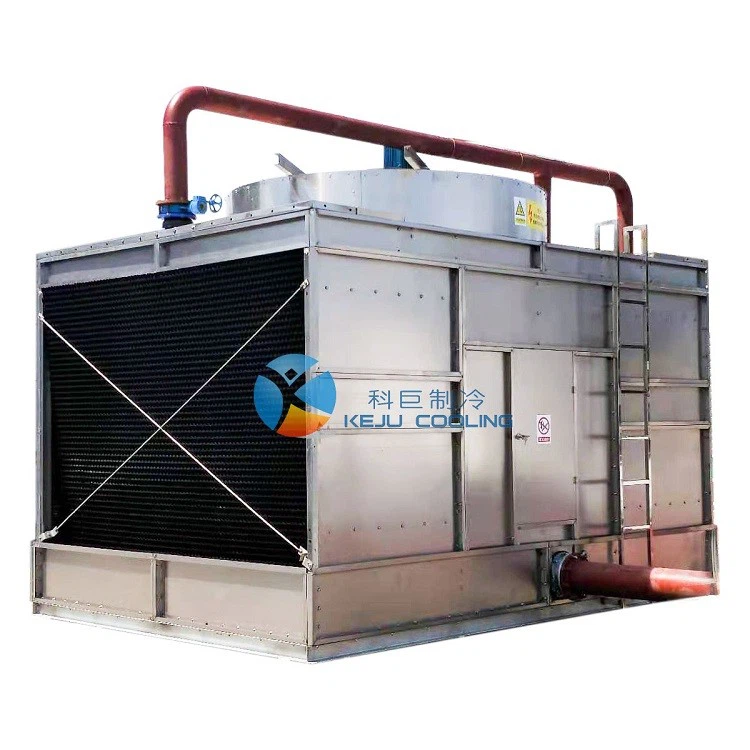
The Square Crossflow Open Circuit Cooling Tower is a popular design choice. Its square shape allows for efficient use of space and provides a good balance between water distribution and airflow. Additionally, the design of the water distribution system, such as the nozzles and basins, can impact how evenly the water is spread over the fill media. Uneven water distribution can lead to dry spots in the fill media, reducing evaporation efficiency.
6. Water Quality
The quality of the water used in the cooling tower can have a big impact on evaporation efficiency. Water with high levels of dissolved solids, such as calcium and magnesium, can cause scaling on the fill media and other components of the tower. This scaling reduces the surface area available for evaporation and can also impede airflow.
Biological growth, such as algae and bacteria, can also be a problem. These organisms can form slime layers on the fill media, which not only reduce evaporation efficiency but can also cause health issues if the tower is located near a populated area. To maintain good water quality, regular water treatment is necessary, including the use of chemicals to control scaling, corrosion, and biological growth.
7. Operating Conditions
The operating conditions of the cooling tower, such as the load and the ambient temperature, can affect evaporation efficiency. When the cooling tower is operating at a high load (i.e., cooling a large amount of hot water), it may require more airflow and a larger surface area for evaporation. If the tower is not designed to handle the load, evaporation efficiency will decrease.
The ambient temperature also plays a role. In colder weather, the air has a lower capacity to hold water vapor, which can reduce evaporation. However, this can be offset by the fact that the temperature difference between the water and the air is usually greater in cold weather, which can increase the driving force for evaporation.
In conclusion, there are many factors that affect the evaporation efficiency in a steel open water cooling tower. From water temperature and airflow to fill media and water quality, each factor plays a crucial role in the overall performance of the tower. As a supplier, we understand the importance of these factors and strive to provide high - quality cooling towers that are designed to optimize evaporation efficiency.
If you're in the market for a Steel Crossflow Open Cooling Tower or have any questions about evaporation efficiency in cooling towers, don't hesitate to reach out. We're here to help you find the best solution for your needs. Let's start a conversation about how we can improve your cooling system's performance through efficient evaporation.
References
- Cooling Tower Institute. (20XX). Cooling Tower Handbook.
- ASHRAE. (20XX). Handbook of HVAC Systems and Equipment.
- Water Treatment Association. (20XX). Water Quality Guidelines for Cooling Towers.